Since 1872
Add Caldwell Walks to Blacksburg
A 16-year-old from Craig County, a brand-new college, and a record that took a century to read right.
- 1862Lincoln signs the Morrill Land-Grant College Act on July 2.
- 1870Virginia rejoins the Union in January and can claim land-grant funds.
- 1872March 19: VAMC is created. October 1: it opens, and Add Caldwell enrolls first.
- 1873President Minor’s January 8 report lists Caldwell first, with a scholarship mark.
- 1876Caldwell graduates with the second class on August 9.
- 1910Caldwell dies in Wilmington, North Carolina.
- 1997A state historical marker goes up near the Caldwell farm in Craig County.
- 2006The statue “Walking Toward the Light” is unveiled on October 20.
- 2017The statue moves to the steps between the Upper Quad and Alumni Mall.
A college built on a Civil War law
Virginia Tech starts with a bill Abraham Lincoln signed on July 2, 1862. The Morrill Land-Grant College Act gave each state land scrip for 30,000 acres of public land per member of Congress, to fund schools teaching agriculture, engineering and military tactics.
Virginia had seceded, so it could not touch that money until it rejoined the Union in January 1870. Then the General Assembly spent two sessions arguing over where the money should go, and whether to split it between a school for Black students and one for white students.
They split it. On March 19, 1872, Governor Gilbert C. Walker signed the bill creating the Virginia Agricultural and Mechanical College at Blacksburg. Two-thirds of the fund went to VAMC, for white men. One-third went to Hampton Normal and Agricultural Institute, for Black students.
The university’s own 150th-anniversary history is plain about the rest. The land-grant money came from selling western lands the federal government took from Indigenous peoples. The Tutelo and Monacan peoples were the traditional custodians of the land in Blacksburg. More than 200 enslaved African and African American people lived and worked on the Preston family’s Smithfield and Solitude estates, part of the land that became Virginia Tech.
Opening day
Montgomery County residents pledged $20,000, and the new college bought the small campus of the Preston and Olin Institute. For its first four years, one building did everything: dorm, classrooms, chapel, library, armory, infirmary and shop. Students ate in town.
VAMC opened on October 1, 1872. Twenty-nine students had enrolled within a week. By the end of October there were 88, and by the end of the first session, 132.
The first name on the list was William Addison Caldwell.
The walk
Add Caldwell was born January 10, 1856, in Sinking Creek, Craig County, the second of nine children. He was 16 when he walked from Craig County to Blacksburg and enrolled on opening day.
The trip was about 26 miles. Sources disagree by a mile or two, which is fair for a hike nobody measured at the time.
His older brother Milton, called Mic, made the walk with him. Mic waited until November 2 to register. Add’s name went down first.
The detective plot
For decades the story was that Caldwell wandered in out of curiosity, with no scholarship and no real plan. A respected 1972 centennial history repeated that legend.
Then university editor Clara Cox went looking for proof. She found President Charles Minor’s January 8, 1873 report to the governor. It lists Caldwell first, for October 1, with an “A” beside his name. That letter meant a county school board scholarship.
So he came on purpose. The scholarship covered $30 in tuition and $10 in fees. He was not a curious drop-in. He was a kid from the mountains with a plan and a way to pay for it.
Minor’s own letters show what that first class was like. He described the new students as mostly “plain lads” who needed to relearn grammar-school material before college work could start.
A very relatable Hokie
Caldwell made second sergeant of Company B and joined the Maury Literary Society. His 1875 report card shows him strong in written composition, military tactics and farm work, and “tolerable” or worse in math and bookkeeping.
He took an extra year to finish the three-year agriculture program and graduated with VAMC’s second class on August 9, 1876. His classmates elected him secretary of their alumni association.
After that he taught school in Craig County, clerked for the Norfolk and Western Railway in Roanoke, tried Roanoke real estate, and moved to Wilmington, North Carolina, in 1898. His last job was as a hotel clerk at Wrightsville Beach.
He died in a Wilmington hospital on June 29, 1910, after a brain tumor and a fall. He is buried in the family cemetery near Radford.
Where you find him now
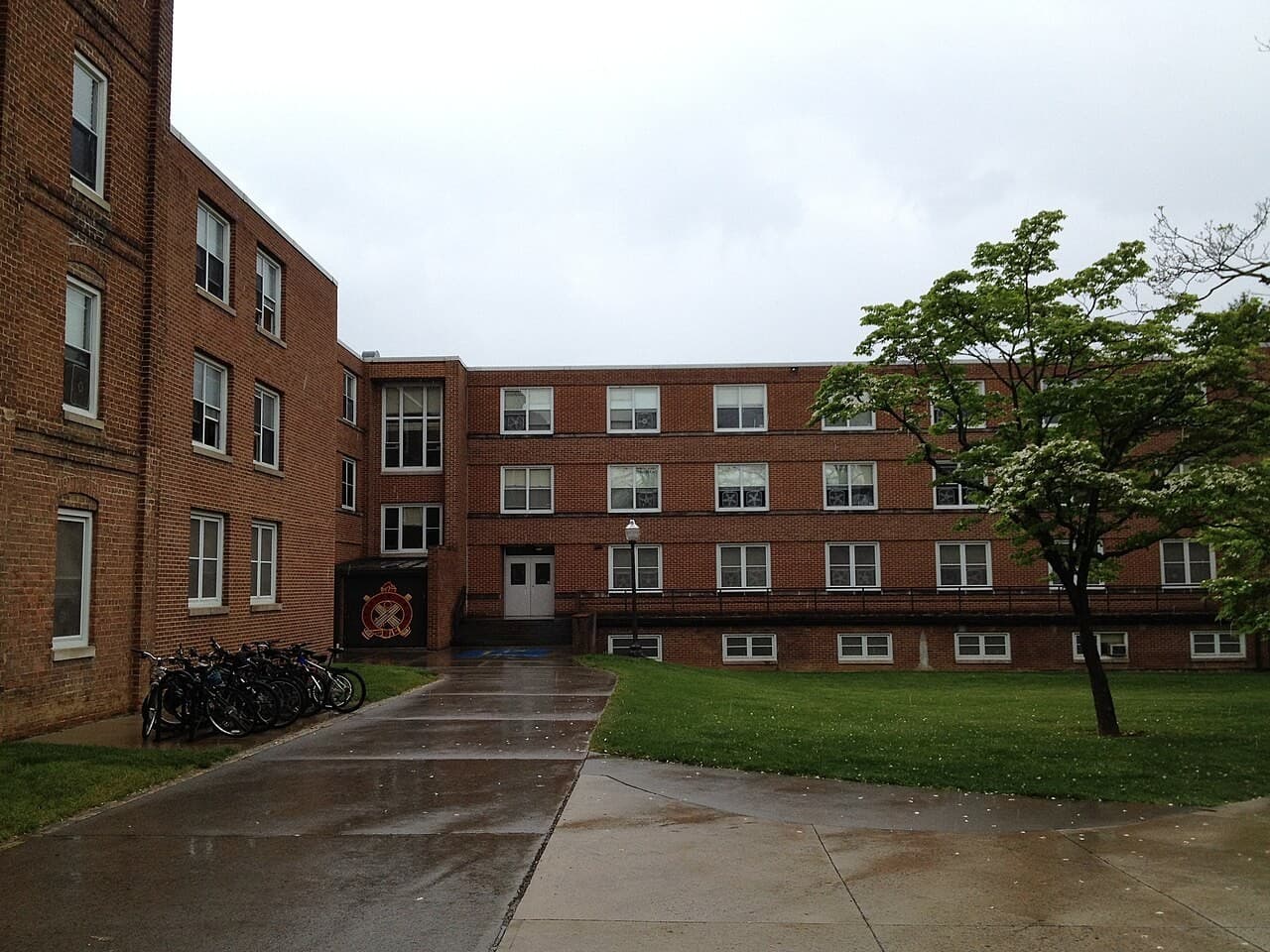
Lawrence Bechtel’s life-size statue, “Walking Toward the Light,” was a gift of the Class of 1956. It was unveiled on October 20, 2006, near Rasche Hall, and in 2017 it moved to the steps between the Upper Quad and Alumni Mall.
His name is all over the place once you look: the Add Caldwell Lounge in the student center, “Addison,” the library catalog, and the Caldwell Fields campground in Jefferson National Forest, whose three sections are named for Addison, Mic and Frank. A state historical marker went up near the family farm in Craig County in 1997.
And every year, first-year cadets walk it again. The Caldwell March is split into two 13-mile marches, one in the fall and one in the spring. Commandant Maj. Gen. Jerry Allen explained the split simply: camping 350 people overnight was not practical.
It is a newer tradition than it feels. In a 2005 magazine story, a cadet described it as one that had started only a few years earlier.
Finishing the fall march ends Red Phase. The spring march climbs about 900 feet up Brush Mountain and ends on the Upper Quad, with the Highty-Tighties playing and Skipper firing. Freshmen stand inside the “VT,” upperclassmen walk out to face them, and from then on everyone is on a first-name basis.